How to turn listing photos into real estate videos: A practical playbook
Learn how converting photos into videos in real estate marketing helps agents create faster campaigns, stronger listing promotion, and better digital marketing results.
6 minute read
Converting photos into videos in real estate marketing becomes one of the fastest ways to get more value from listing media you already have.
Most agents and marketers already pay for photography. Far fewer turn those same assets into short, usable videos for social posts, listing promotions, email campaigns, and paid ads.
In digital marketing speed and consistency usually beat overproduction. If you can turn a set of listing photos into a clean, persuasive video within hours instead of waiting days for a full video shoot and edit, you can publish faster, test more creative angles, and keep your marketing active without increasing production costs every time.
Why photo-to-video works so well in real estate
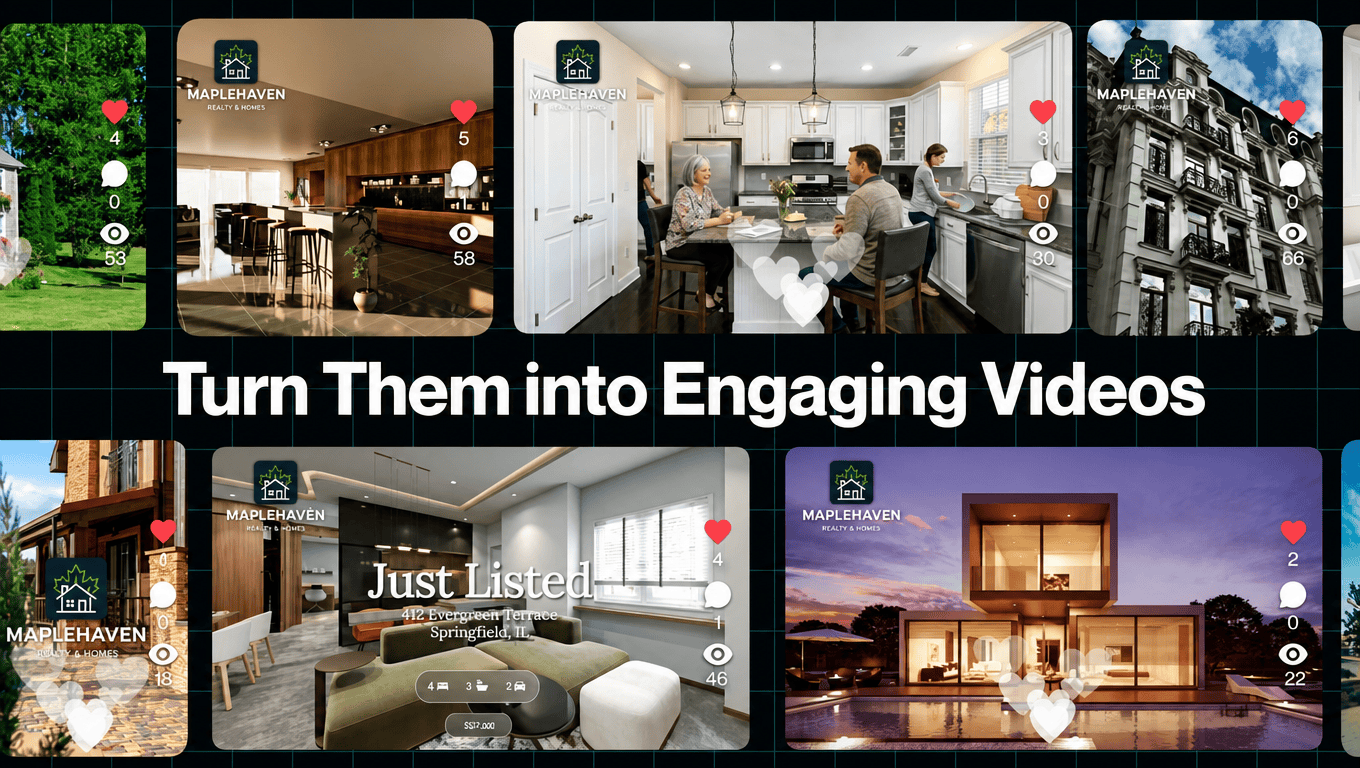
Real estate itself is already a visual category. Homebuyers make snap judgments based on presentation before they read the full listing description. Photos do the heavy lifting, but video changes how those photos are consumed. It creates pacing, emphasis, movement, and mood.
That matters because a static gallery asks the viewer to do the work. A video guides the viewer through the story of the property. It decides what comes first, what deserves focus, and what emotional tone the listing should carry.
For agents, our playbook on how to turn images to video detects three immediate benefits:
- Stretches content library: One photoshoot can support the MLS, listing portals, Instagram Reels, Facebook posts, YouTube Shorts, email newsletters, and even paid campaigns.
- Improves recall: A buyer may forget a photo grid, but they are more likely to remember a short, well-sequenced property video with a clear narrative.
- Gives sellers visible proof: Marketing process is more advanced than simply uploading still images. In a listing presentation, that can make a practical difference.
Where photo-to-video fits in digital marketing for real estate
The biggest mistake is treating this format as a side asset. In digital marketing photo-to-video works best when it supports a larger system.
New listings
It becomes a launch asset. You can use it to create early attention on social media and drive traffic back to the full listing page.
Email marketing
It gives you a stronger featured asset than a single listing image. A short video preview is more useful than a static thumbnail with a generic line of copy.
Social media
It gives you repeatable content at a lower production cost. Instead of posting five disconnected photos over a week, you can publish a short property video, a room-specific cut, and a neighborhood angle from the same source material.
Brand marketing
It helps position you as an agent who knows how to package listings. Sellers don’t always know how to judge marketing quality, but they can see the difference between basic presentation and a coordinated campaign.
What makes a photo-to-video real estate asset effective
Not every slideshow works. Some feel like filler because they are built without a point of view. Our playbook defines following effective points:
Sequence
The order of images should feel intentional. Start with the strongest exterior or hero shot, then move through the spaces in a way that makes sense to a buyer. The video should feel like a guided preview, not a random stack of media.
Pacing
Most real estate photo-to-video assets work better when they are short. In many cases, 15 to 45 seconds is enough. If the video drags, the content starts to feel repetitive. The goal is not to show every image creating enough interest for the viewer to take the next step.
Framing
Text overlays, transitions, music, and motion effects should support the property, not distract from it. Many agents over-edit these videos and make them feel generic. Clean beats flashy most of the time.
Message
A luxury listing, an investment property, and a starter home shouldn’t use the same creative structure. The video should match the likely buyer and the purpose of the campaign.
How to use photo-to-video across channels
The easiest way to get results is to adapt one core asset into multiple versions. Create a vertical version for Instagram Reels, TikTok, and YouTube Shorts. This version should be fast, visual, and built for attention in the first few seconds.
Create a square or horizontal version for Facebook, landing pages, and email. This version can be slightly slower and more informational.
Create a seller-facing version for your listing presentation. This one should show how you market a property, not just the property itself. It helps potential clients understand your process.
Create paid-ad variations if you are running campaigns. One version might focus on the home itself. Another might focus on a neighborhood angle, price point, or feature set.
Using this approach makes photo-to-video content especially useful. You can test multiple hooks without reshooting anything because one asset generation process supports multiple outcomes.
When photo-to-video is better than a full video shoot
A full video shoot is still valuable, especially for high-end listings, properties with strong flow, or campaigns built around lifestyle storytelling. But it is not always necessary.
Photo-to-video works better when speed matters, the budget is tighter, the listing needs same-day promotion, or the content is meant for short-form distribution rather than a flagship brand film.
What to avoid
Avoid making the video too generic. If every listing gets the same template, same pacing, and same text, the result starts to feel automated in the wrong way.
Another mistake is including too much information. A short property video doesn’t need every room, every detail, and every feature callout. It needs enough structure to create interest.
Low-quality motion effects are another issue. If the zoom, pan, transition, or text animation looks forced, the video feels cheaper than the original photography. You can always use a video enhancer to upgrade resolution and fix the majority of artefacts.
Conclusion
Converting photos into videos in real estate marketing is valuable because it solves a practical problem where agents need more content, faster turnarounds, and better reuse of existing media.
The real advantage isn’t that it looks modern, but it makes your media library work harder.
If your current marketing strategy still treats listing photos as a one-time deliverable, using our playbook will optimize reach, overall efficiency, and seller-facing proof on the table.