How to write real estate video messaging that works
Learn how to write real estate video messaging that makes listing videos, Reels, and seller-facing content clearer, more persuasive, and easier to act on.
6 minute read
Most real estate videos don’t fail because the footage is bad. They fail because the viewer never gets a clear reason to care.
A listing video can have clean camera work, polished edits, and good music. But if the message sounds like every other property video, buyers will skim past it and sellers won’t see much strategy behind it.
Strong real estate video messaging gives the viewer a reason to keep watching in the first few seconds. In this guide, we will break down how to choose the right message, write sharper hooks, and match your script to the platform where the video will appear.
Why messaging matters more than production
Many agents assume video performance depends mostly on visuals. Good visuals matter, but they aren’t enough. A beautiful property video with generic narration still feels generic. A simpler video with sharper messaging often performs better because it gives the viewer context and direction.
In real estate, viewers aren’t just watching for entertainment. They are trying to decide whether a home fits their needs, whether an agent feels credible, or whether a property is worth clicking on. The message is what helps them make that decision.
If your messaging is sharp, focused, and specific, you look like an agent with a real strategy.
Use this real estate video messaging framework
If you aren’t sure how to turn an idea into a usable script, use this simple structure:
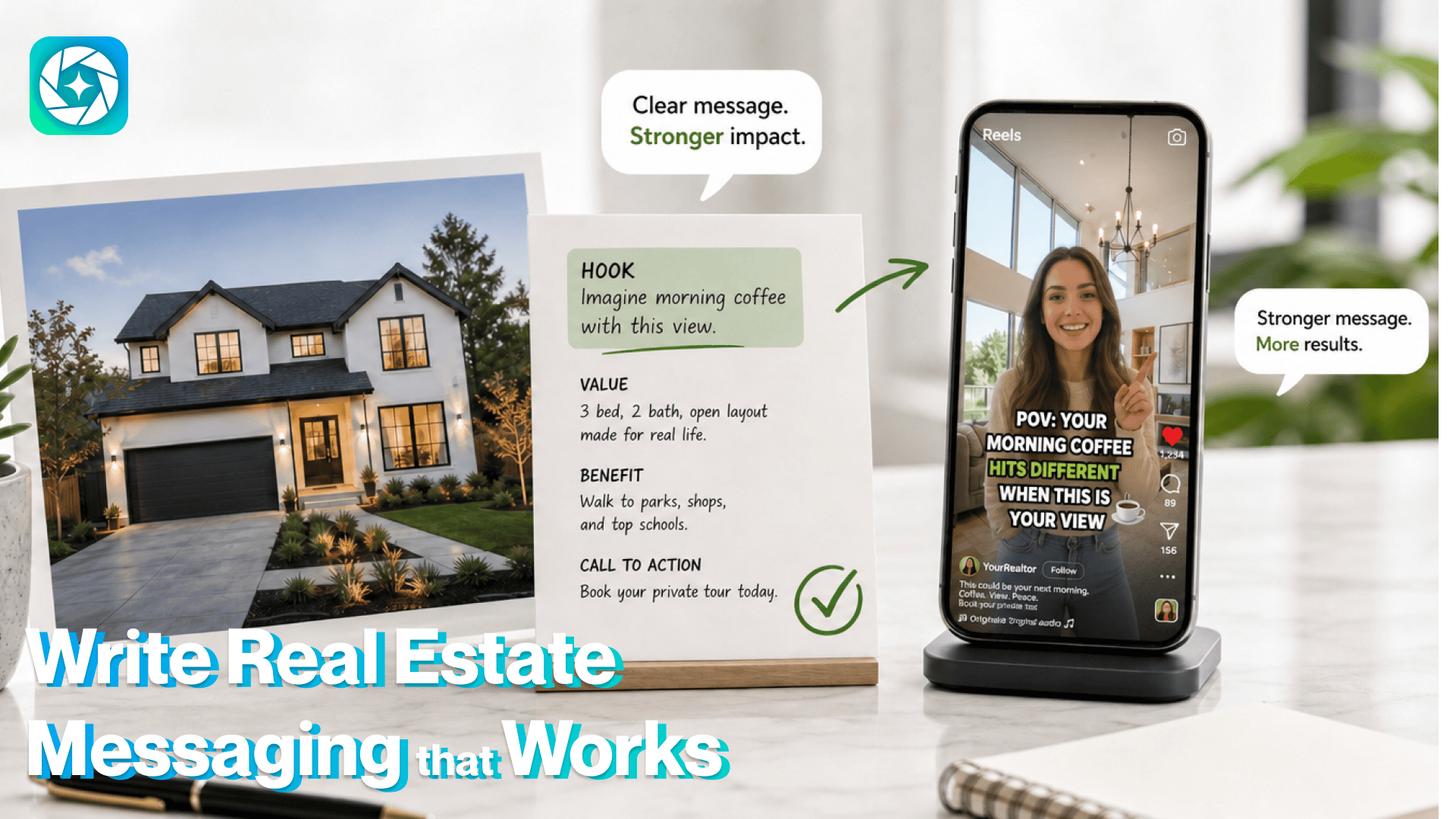
Hook → Core angle → 2 proof points → Buyer or seller relevance → Next step
The hook earns attention. The core angle tells the viewer what the video is really about. The proof points make the message believable. The relevance explains why the viewer should care. The next step tells them what to do after watching.
Here is how that works in practice:
Hook: “This isn’t just a renovated home. It is a layout that solves one of the biggest problems buyers have right now: needing more usable space without moving too far out.”
Core angle: The home gives buyers flexible space in a convenient location.
Proof point 1: The main living area connects directly to the kitchen and dining space, which makes the home feel open without wasting square footage.
Proof point 2: The extra room can work as a home office, guest room, or playroom, depending on what the buyer needs most.
Buyer relevance: Instead of only getting more rooms, the buyer gets a home that can adjust as their life changes.
Next step: “If you want a home with more flexibility without giving up location, this one is worth a closer look.”
That structure keeps the script focused. It also prevents the video from becoming a room-by-room tour with no clear reason to keep watching.
Examples of strong real estate video hooks
Several messaging angles tend to work consistently in real estate.
“Why this home” angle: This works well when the property has a clear advantage, such as natural light, layout, land, updates, or neighborhood access. It gives the video immediate direction.
“Who this is for” angle: Some homes suit a distinct buyer profile. Framing the message around that fit can make the property easier to imagine in real life.
“Why now” angle: This is effective when timing matters, whether because of market conditions, limited inventory, seasonal shifts, or price movement.
“How we market this” angle: This matters for seller-facing content and for broader real estate video strategy. It helps position the agent as deliberate and current, not just active online.
These angles work because they turn raw visuals into a story with purpose.
Turn listing features into buyer-relevant benefits
Weak video script drafts sound like they were copied from brochure language. Words such as:
- Stunning
- Gorgeous,
- Must-see
- One-of-a-kind
appear so often that they stop meaning anything.
Good messaging sounds more like a smart agent explaining why something matters. It translates features into relevance. Instead of simply describing the kitchen, it explains why the kitchen changes how the home lives. Instead of saying a location is great, it explains what that location gives the buyer access to.
Match the message to the platform
One of the biggest problems in real estate video marketing is using the same messaging everywhere. A listing page, an Instagram Reel, a seller presentation, and a follow-up email don’t all need the same words.
On social media, the message needs to earn attention fast. The best real estate social media video hooks are specific, local, or slightly surprising. They make the viewer feel there is a reason to keep watching.
On a listing page, the message can be calmer and more explanatory. The viewer already has some interest, so the job is to deepen confidence and clarify value.
In a seller presentation, the message should focus more on process and differentiation. It shows how you think, package, and promote a listing.
Common script mistakes to avoid
The most common mistake is vague language. If the script sounds like it could apply to any listing, it probably won’t persuade anyone.
Another issue is overexplaining. Shorter videos need sharper choices. If every feature gets equal attention, the central message disappears.
Overwriting also hurts performance. If the language sounds too polished, too salesy, or too artificial, trust drops. A real estate video script should sound natural when spoken aloud.
The final mistake is disconnecting the message from business intent. A video should support a goal, whether that is attention, inquiry, seller trust, or lead generation. If the script doesn’t support that goal, it needs to be rewritten.
Conclusion
The best real estate video messaging isn't the flashiest. It is the clearest, most specific, and easiest to act on.
That is how to write real estate video messaging that works. Focus the point, write with specificity, match the message to the platform, and make every line earn its place. When you do that, the video becomes more than content. It becomes a business asset.