Marketing for real estate agents: What actually works in 2026
Learn what actually works in marketing for real estate agents in 2026, from video and social media to SEO, email, and lead generation systems.
6 minute read
Marketing for real estate agents isn’t a content volume problem anymore. Most agents are already posting, boosting, emailing, or paying for leads. The real gap is structure.
The agents who win more listings aren’t necessarily louder. They are clearer.
This guide breaks down the marketing approach that actually compounds: a simple channel mix, a practical real estate marketing plan, and the tactics that turn attention into conversations.
Why most real estate marketing strategies fail
A lot of real estate marketing strategies look busy but don’t build demand.
Agents post listing photos with no context, try every platform for two weeks, or outsource content before they know what they want the content to do. The result is fragmented visibility caused by:
- The message is too broad. “I help buyers and sellers in my city” isn’t memorable enough. “I help move-up sellers in two specific neighborhoods” is.
- The channel mix is too scattered. If you are trying to maintain Instagram, Facebook, YouTube, a blog, a newsletter, postcards, and cold outreach without a system, quality drops everywhere.
- The content doesn’t connect to a business outcome. Good real estate marketing approach should move people toward a showing request, a listing consultation, a reply, or a referral. If the content never creates a next step, it is just activity.
The four most important marketing channels
You don’t need a twelve-channel media machine. Most agents can build a strong pipeline with just four.
Listing media
This is still the fastest way to prove your value. Great photos, useful video, strong copy, and a clean property story do more than sell the current listing. They market you to the next seller.
Real estate social media marketing for short-form video
Social is where people decide whether you feel current, local, and credible. That doesn’t mean dancing on camera. It means showing listings well, explaining market shifts clearly, and publishing neighborhood-specific content that answers actual buyer and seller questions.
Email remains one of the most underrated real estate marketing ideas because it compounds quietly. A monthly market note, one featured listing, and one useful local insight can keep you top of mind without feeling aggressive.
Search and local presence
Your Google Business Profile, your website pages, and your blog all work together here. A seller searching for an agent in a specific area should find evidence that you know that area better than anyone else.
Start with a real estate marketing plan, not random tactics
A real estate marketing plan doesn’t need to be complicated. It just needs to force decisions.
Audience Pick one seller type, buyer type, or neighborhood cluster that you want to own for the next 90 days. When you narrow the audience, your content gets sharper immediately.
Core message What do you want to be known for? Speed to market, luxury presentation, relocation expertise, investor knowledge, neighborhood depth, or first-time buyer guidance? Pick one lead message and repeat it until the market associates it with you.
Then set a simple publishing rhythm. One listing story, one market insight, one neighborhood piece, and one email per month is enough to build momentum if you do it consistently. The issue for most agents isn’t lack of ideas. It is the lack of repeatable cadence.
Finally, decide what you will measure. Lead generation should be tracked through a few useful signals: inquiries, booked appointments, seller conversations, referral replies, and listing wins. Vanity metrics are fine as supporting data, but they aren’t the point.
Real estate video marketing is now the leverage channel
If there is one format that consistently feeds the rest of the system, it is video. Real estate video marketing works because it gives you one asset that can be reused across listing pages, Instagram Reels, YouTube Shorts, email, and your website.
But most agents still approach video the wrong way. They think every video needs cinematic production. It doesn’t.
In most markets, clarity beats polish. A 45-second video explaining why a listing is priced the way it is, what makes one block more desirable than another, or what buyers miss when they compare two neighborhoods will usually outperform a generic montage.
The same applies to seller-facing content. A seller doesn’t just want to hear that you “do marketing.” They want to see how you market. The video gives you proof. Show your listing process. Show before-and-after presentation improvements. Show how you turn one listing into multiple distribution assets. That is persuasive because it is concrete.
Real estate social media marketing should feel local, not generic
The biggest mistake in real estate social media marketing is copying broad lifestyle content that could belong to any agent in any city. Generic content may fill your feed, but it doesn’t create authority.
The better move is hyperlocal specificity. Talk about one neighborhood, one buyer objection, one pricing trend, one street-level difference, or one selling mistake at a time. The more specific the content, the more likely it is to attract the right attention.
This is where ideas become stronger with a simple edit. A generic post about “tips for selling your home” becomes useful when it turns into “three things sellers in [neighborhood] should fix before listing this spring.”
Specificity isn’t limiting. It is what makes content rank, get shared, and lead to conversations.
Build a system for real estate lead generation
Real estate lead generation usually gets overcomplicated. Most agents don’t need more tools first. They need a tighter follow-up loop.
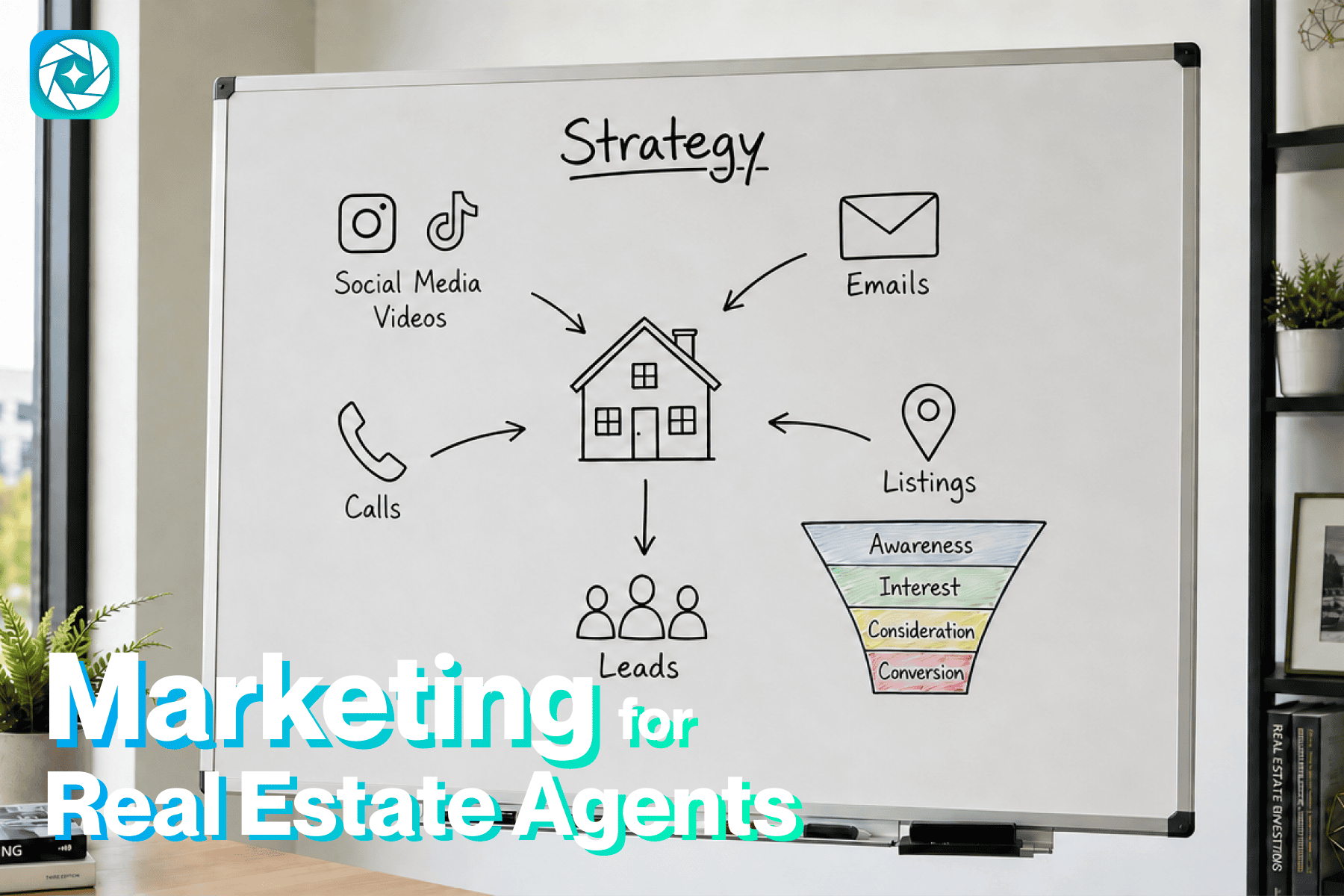
A listing video should lead to a showing or valuation conversation. A blog post should lead to a newsletter signup or listing consultation. A social post should lead to a DM, a saved post, or a site visit.
Once that attention arrives, follow-up speed matters. So does relevance. If someone engages with a neighborhood post, send neighborhood material. If someone clicks a seller guide, send seller-facing follow-up.
Consider designing your marketing funnel as sequence of connected dots. The blog supports search. Search supports trust. Social support reach. Video supports proof. Email supports retention.
Final thoughts
The most successful agents don't market like influencers. They market like operators. They know their audience, they package their expertise clearly, and they use a few repeatable channels well.
If you want better results, ask which message you want to own, which neighborhood or client type you want to be known for, and which assets you can produce consistently for the next 90 days. That is the version of marketing for real estate agents that actually compounds.