Why real estate social media isn’t working and what agents should post instead
Learn why most real estate social media posts fail and what agents should post instead to attract buyers, sellers, and better leads.
7 minute read
Real estate social media isn’t failing because buyers stopped using social platforms. It is failing because too many agents are posting content that gives no reason to stop, trust, save, or message.
The National Association of REALTORS® Technology Survey shows that social media is still one of the most used tools in the business. It reported that 75% of realtors use social media, and social media remained the top lead-generating technology at 39%. So the channel isn’t dead. The problem is the content.
What agents should post instead
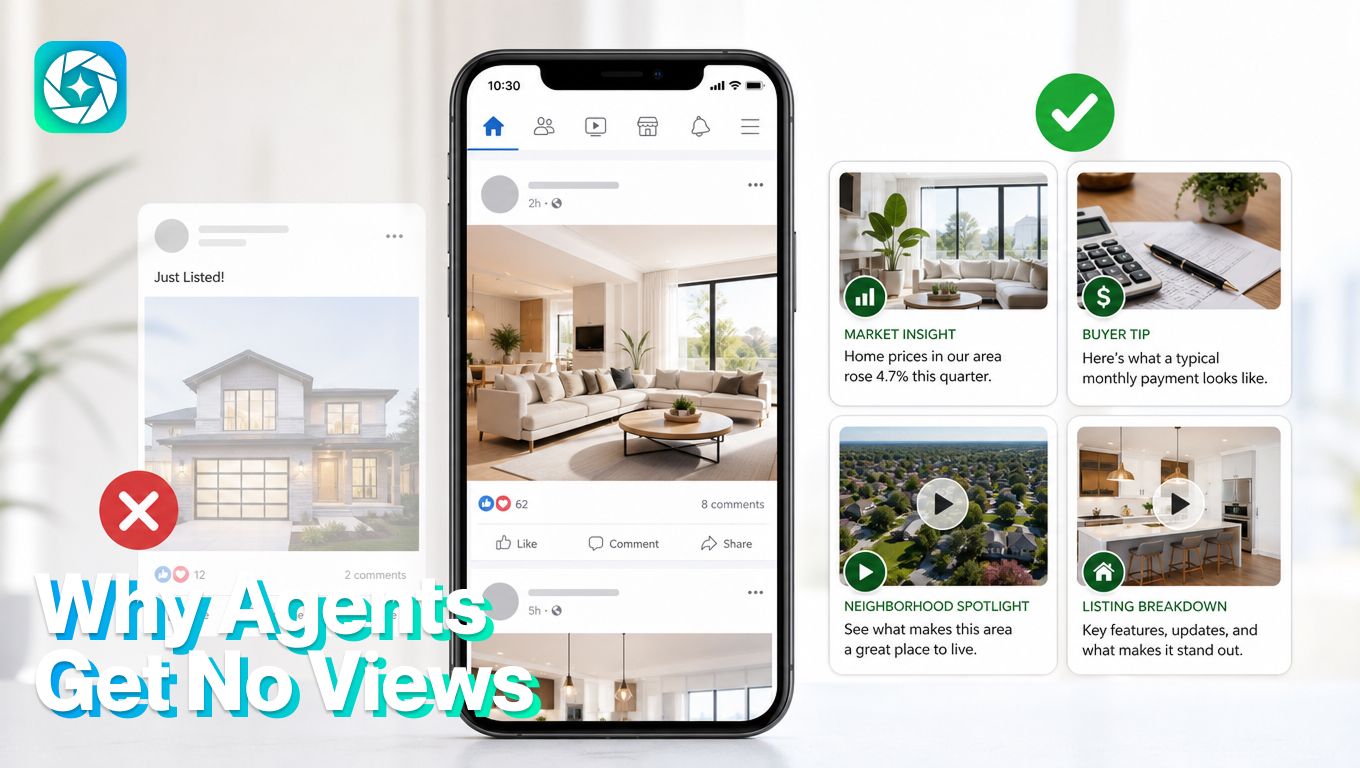
The best real estate social media content usually does one of four jobs: explains the market, clarifies a listing, reduces buyer or seller uncertainty, or proves the agent’s process. If a post doesn’t do one of those things, it is probably just filling space.
| Content type | Audience | What it answers | Example post | Best format |
|---|---|---|---|---|
| Market translation | Buyers and sellers | What does this market data mean for me? | “Inventory is up, but homes under $500K in this school district are still moving quickly.” | Carousel, short video, email-to-social clip |
| Buyer math | Buyers | Can I afford this, and what changes the payment? | “What a $25,000 price cut actually changes in your monthly payment.” | Reel, carousel, talking-head video |
| Seller reality check | Sellers | What should I know before listing? | “Three signs your price is too high after the first week.” | Carousel, short video, LinkedIn post |
| Listing breakdown | Buyers and sellers | Why does this home matter? | “The best part of this home is not the kitchen. It is how the kitchen opens to the patio.” | Reel, listing clip, carousel |
| Neighborhood decision content | Buyers | What does living here actually feel like? | “Who this neighborhood works for, and who may want the next one over.” | YouTube Short, Reel, blog-to-video clip |
| Process proof | Sellers | Why should I trust this agent? | “What we changed before relaunching this listing.” | Story, case-study post, short video |
| Personal trust content | Buyers and sellers | Who is this agent, and do they seem credible? | “One thing I learned this week from showing homes in this market.” | Story, short caption post, casual video |
Why agent social media feels invisible
The average real estate post asks for attention before it earns attention. A “just listed” post usually assumes the viewer already wants the home. Most don’t.
Good real estate social media should answer one of these questions: Can I afford this market? Should I wait or move now? What should I know before selling? What does this neighborhood actually feel like? Why did this home sell faster than another one? What mistake should I avoid? What does this listing give me that the photos don’t show?
If the post doesn’t answer a question like that, it is probably just noise.
Stop Posting Listings Like Flyers
Listing posts isn't the problem. Lazy listing posts are.
Instead of posting the whole listing every time, break it into sharper content: One Reel about the best room. One carousel explaining the floor plan. One short video showing the walk from kitchen to patio. One post comparing the home to other listings in the same price range. One open house clip answering who the home is best for.
This turns one listing into a small content campaign instead of a single announcement.
Post market translation, not market data
Agents love market updates. Most consumers don't love charts unless the chart helps them make a decision.
This is the kind of content people save. It helps them understand what the market means for them:
Post buyer math
Affordability is still one of the biggest reasons buyers hesitate. That makes payment-focused content more useful than vague motivational content. Agents should post more content that explains the real buying decision:
- What does a $25,000 price reduction actually change in the monthly payment?
- How does a seller's credit compare to a price cut?
- What does a 1% rate difference do to buying power?
Answer that, and your social media becomes more useful immediately.
Post seller reality checks
Social media can help reset expectations before the listing appointment. Useful seller posts include:
- “Three signs your price is too high after the first week.”
- “What buyers notice before they book a showing.”
- “Why do the first 10 days of a listing still matter?”
- “What to fix before photos and what not to waste money on.”
Sellers want confidence, but they also need someone who will tell them what the market is actually doing.
Post neighborhood content with buyer intent
Neighborhood content often fails because it is too broad. A video of a coffee shop or park is pleasant, but it doesn’t always help someone decide where to live.
- Better neighborhood content answers specific lifestyle questions:
- What is the commute like from this area?
- Where do people walk after dinner?
- What kind of buyer usually chooses this neighborhood?
- What is the tradeoff compared with the next neighborhood over?
This works especially well for YouTube, Instagram Reels, TikTok, and blog-to-video content. Buyers search for context.
Post process proof
Agents often post results, but not enough process. A process post shows why the agent was useful.
Here are some good examples:
- “How we helped this seller choose between two offers.”
- “What we changed before relaunching this listing.”
- “The inspection issue that almost killed the deal and how it was handled.”
This kind of content builds trust because it shows judgment. It proves the agent does more than unlock doors and post listings.
Post short video that answers one question
Short-form video works best when each post has one job. Don’t try to explain the entire market in 30 seconds.
Good short video ideas:
- “Would I buy this home at this price?”
- “The one thing buyers will love about this listing.”
- “The one thing sellers should fix before photos.”
- Why does this home feel bigger than the square footage says?”
This is the difference between content and clutter. One post, one idea, one useful takeaway.
Match the post to the channel
Not every post belongs everywhere. Instagram is strong for visual trust: listing clips, neighborhood reels, before-and-after prep, carousels, client education, and agent personality. TikTok rewards sharper hooks and more direct commentary. Use it for opinions, walkthrough reactions, quick buyer lessons, and “things I would watch out for” videos. Treat every platform like a https://www.nar.realtor/research-and-statistics/research-reports/realtor-technology-surveydifferent bulletin board.
Final takeaway
Real estate social media isn’t working for many agents because it is too agent-centered. The fix is to post around buyer and seller decisions. Explain the market. Show the tradeoffs. Make listings easier to understand. Teach people how to think. Prove your process. Match the format to the channel. Social media still works when the content helps people move from confused to clearer. That is the job.