Trends in real estate: What is actually changing in 2026
Explore the most important trends in real estate for 2026, from mortgage rates and homebuyer behavior to proptech, marketing, and investment shifts.
10 minute read
In 2026, trends in real estate are less about dramatic resets and more about pressure points. The market isn’t frozen, but it isn’t loose either. Mortgage rates remain elevated, affordability is still tight, and buyers are more selective than they were during the faster-moving years.
At the same time, agents, brokerages, and investors are adjusting to a market where technology, presentation quality, and operational discipline matter more than they did a few years ago.
That is the real story behind this year’s real estate market trends. The industry is still moving, but it is rewarding clarity over noise.
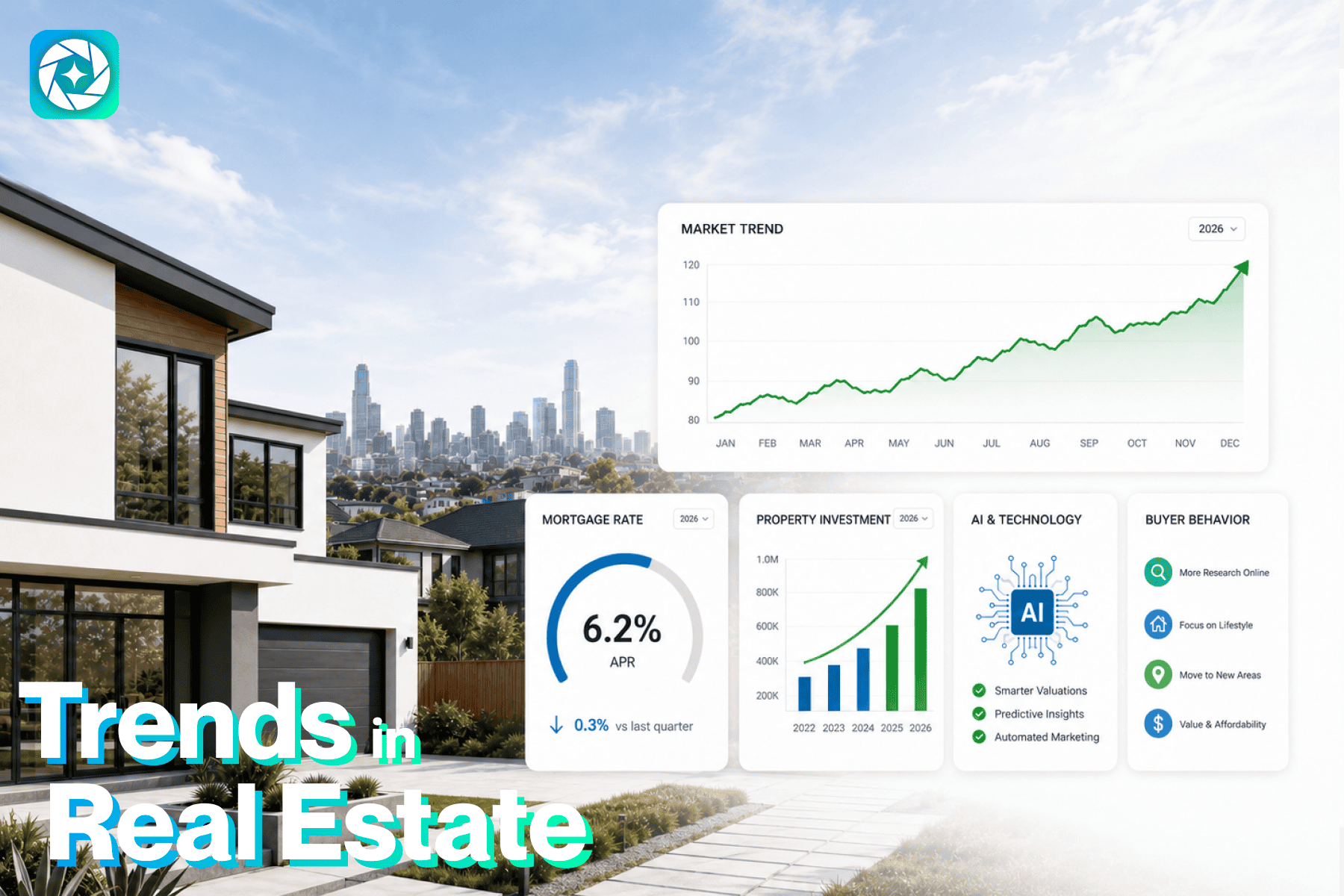
What is actually changing in real estate in 2026
Here is the practical version of what is changing and what each shift means for real estate professionals.
| TREND | WHAT IS CHANGING | WHO IT AFFECTS | WHAT TO DO ABOUT IT |
|---|---|---|---|
| **Mortgage rates ** | Financing costs are still shaping buyer budgets, seller decisions, and listing activity. | Buyers, sellers, agents, lenders, and brokerages | Help clients understand monthly cost, not just asking price. |
| Selective buyers | Buyers are still active, but they are slower to commit and more focused on value, condition, location, and total cost. | Agents, sellers, listing teams, and marketers | Make listings easier to understand. Use stronger photos, clearer descriptions, better pricing context. |
| Sellers & higher expectations | Many sellers have owned their homes longer and built equity, but they may still compare today’s market with faster-moving years. | Listing agents, sellers, and brokerages | Set expectations early. Use local data, presentation quality, and pricing strategy to attract buyers. |
| Technology | AI, proptech, image enhancement, virtual staging, automation, and local reporting are becoming everyday tools. | Agents, teams, brokerages, photographers, and marketers | Use tools that improve speed and consistency, but review outputs carefully. |
| Marketing becomes disciplined | Clearer messaging, better visuals, and hyperlocal relevance matter more. | Agents, brokerages, marketing teams, and listing specialists | Focus on content that helps people make decisions: neighborhood insights, listing media, market explainers, and practical buyer or seller guidance. |
| Selective investment decisions | Higher borrowing costs and tighter margins are making investors more careful about asset fit, demand, operations, and long-term resilience. | Investors, developers, brokers, and asset managers | Look beyond short-term upside and focus on operational strength, location quality, and durable demand. |
Taken together, these trends show a market where clarity, better presentation, and disciplined execution matter more than broad market momentum.
Mortgage rates are still shaping everything
The biggest reality in housing market trends is that financing still drives the mood of the market.
As of May 28, 2026, Freddie Mac reported the average U.S. 30-year fixed mortgage rate at 6.53%, up slightly from 6.51% the week before. That is below the 6.86% level from a year earlier, but still high enough to keep affordability under pressure.
Higher rates reduce flexibility for move-up buyers, make monthly cost comparisons more painful, and force sellers to compete harder for attention.
The overall result is a market where buyers are active, but less impulsive.
The market is warmer, but not loose
Zillow’s housing outlook projected a warmer market with a modest rise in home values, slightly more sales, and mortgage rates remaining above 6%. That is a useful frame because it explains why the market feels active but not easy.
That shift matters for agents. In a market like this, the work is less about waiting for general demand to rescue weak positioning. It is more about understanding what makes one listing feel more compelling than the next.
Homebuyer behavior is more practical
Buyers are still motivated, but they are less tolerant of ambiguity. They want clearer value, more transparent presentation, and more confidence that the home fits their actual needs.
NAR’s 2025 buyer and seller profile, which still shapes how many agents are reading current behavior, showed just how much equity existing sellers have built.
The typical seller had owned their home for a record 11 years. That matters because many sellers still have room to negotiate from a position of strength, while many buyers are entering the market with much less flexibility. In essence, sellers may still feel anchored to older price expectations, while buyers are more payment-sensitive and comparison-driven.
Real estate technology is moving from experiment to infrastructure
Among the clearest real estate technology trends is the shift from curiosity to workflow adoption. A few years ago, AI and proptech often felt like optional experimentation.
That doesn’t mean every new tool matters. It means the useful ones are getting absorbed into everyday work. AI-assisted listing copy, image enhancement, virtual staging, follow-up automation, content repurposing, and local market reporting are becoming normal parts of agent workflows.
The question is no longer whether these tools exist, but whether they improve speed, consistency, and output quality without hurting trust.
Marketing is becoming more disciplined
Real estate marketing trends are moving away from volume for its own sake. More agents now understand that posting more content isn’t the same as building more demand.
That shift is visible across short-form video, neighborhood content, listing campaigns, and search-driven blog content. Broad, generic messaging is losing power. Hyperlocal content, strong listing visuals, and practical educational content are gaining ground because they help buyers and sellers make decisions faster.
What these trends actually mean for agents
Trends in real estate are favoring agents who can reduce uncertainty. If you can explain a market clearly, present listings well, use technology without making the output feel automated you are in a stronger position.
The same applies to brokerages and teams. Process matters more when the market is less forgiving. Better follow-up, sharper messaging, cleaner media, and smarter tech use aren't small upgrades now. They are competitive advantages.