How real estate agents can use the hologram trend without overdoing it
Learn how hologram building videos fit real estate marketing and how to use AI tools to create property reveal videos from listing assets.
7 minute read
Hologram building videos are one of those social media formats that make people stop scrolling because the property doesn’t appear in the usual way.
Instead of a standard exterior shot, the building feels like it is being projected, scanned, assembled, or revealed as a digital object. It looks futuristic. The key is using the trend for the right kind of property and the right kind of message.
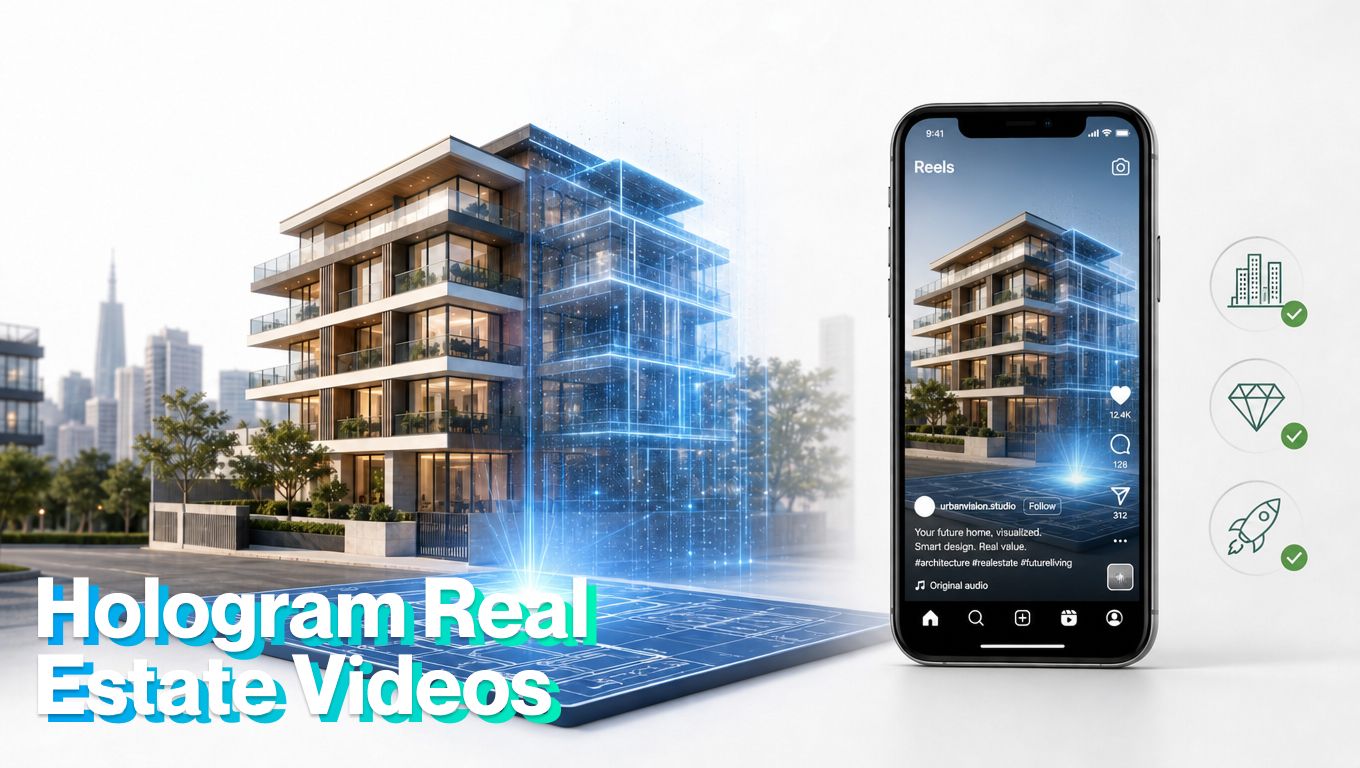
What is a hologram building video?
A hologram building video is usually not a true hologram. In social media marketing, the term often refers to a visual effect where a building appears as a glowing projection, digital scan, 3D-style model, or futuristic reveal.
The effect can show the property appearing over a street scene, rising from a blueprint, forming from light, or being introduced like a premium product launch.
In real estate, that can be useful for:
- New developments
- Luxury listings
- Commercial properties
- Apartment buildings
- Off-plan projects
- Architectural homes
- Pre-construction campaigns
- Open house announcements
- Brand-forward agent content
It is especially strong when the building itself is the product.
When to use hologram building videos
Hologram-style videos work best when the effect supports the property story. If the effect becomes more interesting than the listing itself, it can feel gimmicky. Use the format when it helps introduce the building, not when it distracts from what buyers need to understand.
| Use it when | Skip it when | Better alternative |
|---|---|---|
| The building itself is the main selling point | The property is a standard home with no distinctive exterior | Clean listing video or walkthrough |
| The campaign needs a launch-style reveal | Buyers need practical room-by-room clarity first | Interior listing video or full property tour |
| The project is pre-construction, adaptive reuse, or still being repositioned | The visual could imply a finished result that does not exist | Clearly labeled rendering, concept video, or before-and-after explanation |
| The goal is to stop the scroll on social media | The viewer needs detailed property facts before visual drama | Carousel, property landing page, or standard listing reel |
| The video is promoting an open house, launch, or development announcement | The listing is better served by showing livability, layout, or condition | Open house walkthrough, agent-led video, or neighborhood reel |
Why this trend fits real estate
Real estate is visual, but much of the content is predictable. In comparison to other real estate trends, a hologram-style video helps solve three marketing problems:
Creates a stronger hook
The first few seconds of a social video matter. A digital building reveal gives viewers a reason to pause before they know the address, price, or square footage.
Makes the future property feel more palpable
This is great for developments, and listings where design, architecture, or location needs to feel elevated.
Explains future potential
For pre-construction, renovation, adaptive reuse, and development projects, a hologram-style reveal can make the “future state” easier to imagine.
Where agents should use it
This format isn’t right for every listing.
A basic suburban home doesn’t always need a futuristic building. In that case, a clean walkthrough, listing video shot on an Android phone or iPhone, drone clip, or neighborhood reel may do more.
Hologram building videos work better when the marketing needs a launch feel. Here is when to use it:
- Use it for a new listing teaser before the full property tour goes live.
- Use it for a development announcement when the building is still under construction.
- Use it for a luxury property where the architecture is part of the appeal.
- Use it for a commercial listing where scale, location, and identity matter.
- Use it for an open house campaign when you want the event to feel more noticeable on social media.
The best version of this trend has a clear mission to make the building more memorable.
How to make hologram videos with AI
You can use TensorPix platform to turn listing photos, property details, and brand assets into real estate marketing videos faster than starting from a blank editing timeline.
1. Prepare property photos
Choose the best listing photos before you start. Decide what kind of video you need before building it. Vertical works best for Instagram Reels, TikTok, YouTube Shorts, and Facebook Reels. Horizontal works better for YouTube, property pages, listing presentations, and email.
Login on the TensorPix platform, and open the Video Generator app. Add selected photos, starting in the right order from the property blueprint as the first frame, and the final outcome of the property seen from the exterior as the last frame. In this way the video builds up with the strongest visual story from blueprint to a glowing projection of what is about to become.Then add the prompt:
Create a polished real estate listing video from these photos. Start with the [Image 1 name], then move to the [Image 2 name]. Use the provided building/property image as the accurate source. Start with a clean dark or neutral background, then make the building appear as a glowing blue-white holographic projection. The structure should assemble from thin light lines, scanning beams, wireframe edges, and subtle particle effects. Keep the architecture accurate and recognizable. Don’t change the building shape, windows, facade, roofline, surrounding context, or proportions.
Camera movement: slow cinematic push-in with a slight orbit/parallax around the building. Add a soft digital scan passing from bottom to top, then resolve into a polished semi-transparent hologram. Keep motion smooth, premium, and modern.
End with a clean call-to-action frame for a showing, open house, or listing inquiry.
2. Select the music
Choose between different music themes that match the property. A luxury home, family home, rental, and open house reminder shouldn’t all use the same tone.
3. Review for accuracy
Before exporting, check every frame. Make sure the video doesn't imply features the property doesn’t have. AI can create a strong first draft, but the agent still needs to review it like any other listing material.
4. Generate your first video
Create the version that matches the channel. If the listing will be promoted in several places, generate more than one version and download it once satisfied with the final outcome.
Use the trend without misleading buyers
This is where real estate marketers need to be careful.
A hologram-style video can make a property feel exciting, but it shouldn’t misrepresent the listing. Don’t change the building shape, add fake amenities, invent views, remove neighboring structures, or make an unfinished project look completed unless it is clearly labeled as a concept or rendering.
Wired has reported on growing concerns around AI-generated real estate media that looks polished but can mislead buyers. That matters because real estate isn’t a low-stakes purchase. Buyers need creative marketing, but they also need accuracy. The safest rule is simple: use the hologram effect to introduce the property, not to fake the property.Final takeaway
Hologram building videos work because they make a property feel like a launch, not just another listing. For real estate agents, brokers, developers, and property marketers, the trend is useful when the building has enough visual or strategic value to deserve a bigger reveal. It works especially well for new developments, and social-first listing campaigns.