Real estate marketing challenges in 2026: What midyear trends reveal
Explore the biggest real estate marketing challenges detected midyear 2026, from affordability and buyer hesitation to AI, video, and private listings.
5 minute read
Real estate marketing challenges in the first half of 2026 became harder for one main reason: the market stopped behaving like one market.
Some sellers are still expecting pandemic-era outcomes. Some buyers have more leverage but still can’t afford the payment. Some metros are seeing price cuts and rising inventory, while others still have tight supply and competitive bidding.
At the same time, AI tools, private listings, and changing search behavior are forcing agents to rethink how they earn attention and trust.
Affordability is still the first marketing obstacle
The biggest real estate marketing challenge today isn’t content. It is affordability.
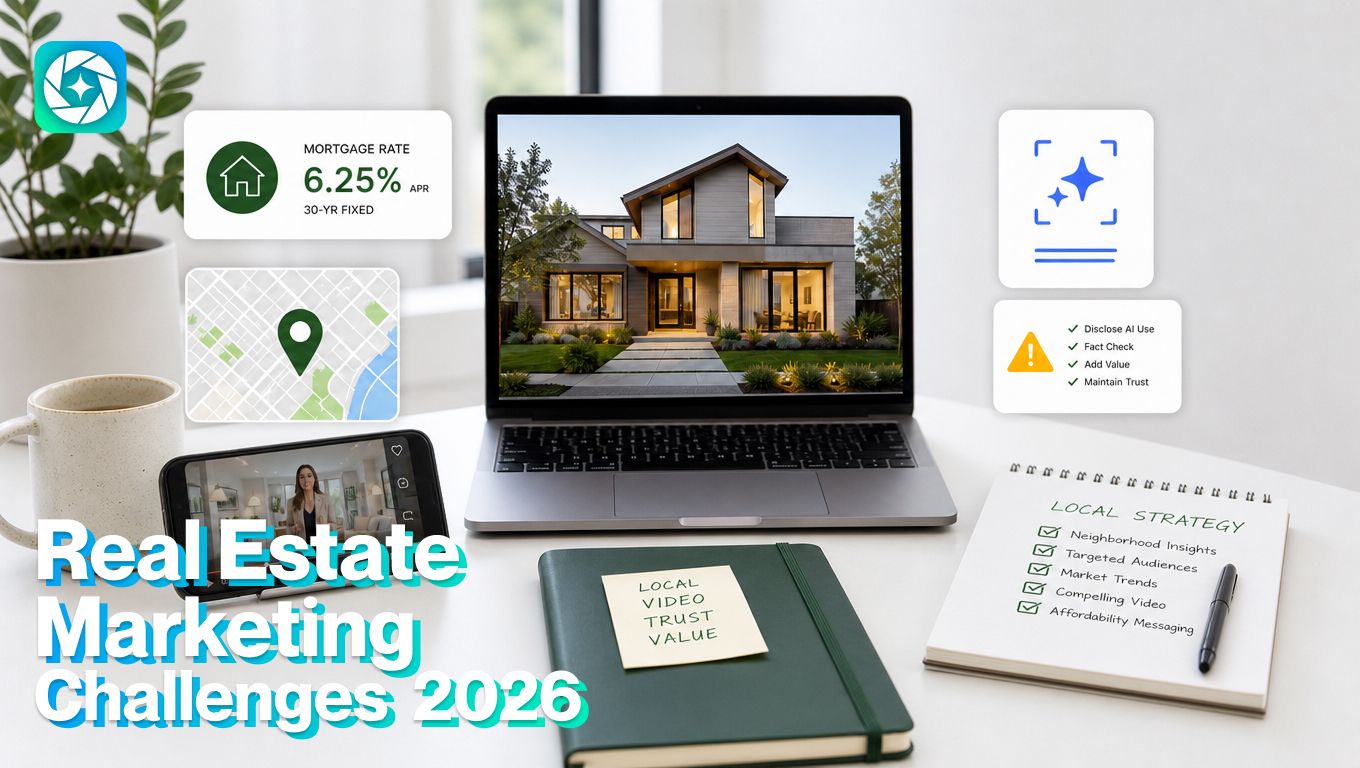
As of June 11, 2026, Freddie Mac reported the average 30-year fixed mortgage rate at 6.52%. That is lower than a year earlier, but still high enough to keep many buyers sensitive to monthly payment, insurance, taxes, HOA fees, and closing costs. That changes how listings need to be marketed.
Strong marketing needs to connect features to financial reality. “Updated roof,” “new HVAC,” “low HOA,” “energy-efficient windows,” and “seller credit available” matter because they reduce uncertainty. Pretty photos still help. Clear buyer math helps more.
Buyers have more leverage, but not everywhere
National headlines can be misleading in 2026. In some markets, buyers have gained negotiating power. In others, inventory is still tight and good homes move quickly. Redfin reported a wide gap between sellers and buyers nationally, and a high share of price reductions in markets such as Texas and Florida. But Northeast and Midwest markets have remained much tighter in several reports, with some metros still behaving like seller’s markets.
That creates a messaging problem for agents.
Generic copy like “hot market,” “rare opportunity,” or “won’t last” can backfire if the local data says otherwise. In slower markets, buyers may read that language as denial. In tighter markets, sellers may still need education on pricing because buyers aren’t as reckless as they were in 2021.
The solution lies in local positioning.
Seller expectations are becoming a marketing risk
The first half of the year exposed a seller psychology problem. Many sellers understand that rates are higher. Fewer have fully accepted what that means for pricing, days on market, and concessions.
That is why listing strategy matters before the home goes live. . If a home is overpriced, no amount of social media content can save the launch. The listing starts to age, buyers notice the mismatch, and later price cuts can feel like weakness rather than strategy.
Marketing teams need to build seller education into the process:
- Show competing listings before setting price
- Explain what buyers can afford at current rates
- Prepare sellers for inspection requests and concessions
- Use launch-week traffic and save as early feedback
Adjust quickly if the market rejects the price.
Private listings are creating new visibility questions
Another major marketing challenge in real estate is the fight over private listings, pocket listings, and listing distribution.
In the first half of the year, states including New York, Washington, Connecticut, and Wisconsin moved to restrict or scrutinize private listing practices. The core issue is simple: when listings stay inside private networks, buyers may not see all available homes, and sellers may not get full market exposure. For agents, this creates a marketing dilemma.
Some sellers want privacy. Some brokerages want exclusive inventory. But most sellers still benefit from broad exposure, especially in a market where buyer demand is thinner.
This means agents need to be clearer about listing distribution. Where will the property appear? Will it be on the MLS? Will it syndicate to major portals? Will it be marketed publicly, privately, or in stages? What are the tradeoffs?
Video is becoming expected, not extra
The NAR REALTOR Technology Survey shows how normal digital tools have become: social media, drone photography/video, and AI are now part of the standard agent toolkit. Social media was also listed as the top lead-generating technology among surveyed realtors.
The challenge now isn’t just whether agents can make videos. It is whether they can make video consistently enough for it to become part of every listing workflow. Case study reveals increased video coverage from 40% to 90% of new listings by turning listing photos and descriptions into short-form videos. The team also increased the number of monthly videos posted on TikTok and Instagram by 49%, while engagement rose by roughly 32% on TikTok and 26% on Instagram.
AI-generated listing media needs more trust
AI is useful in real estate marketing, but the first half also made the risks clearer.
AI staging, image enhancement, and virtual remodeling can help buyers visualize a property. But if the final image misrepresents the home, it creates disappointment and compliance risk.
California’s AB 723, effective January 1, 2026, requires disclosure for certain digitally altered real estate listing images and access to original versions. That law is specific to California, but the trust issue is broader.
The practical rule is: use AI to clarify potential, not fake conditions. Label altered images clearly. Keep original photos available. Don’t change views, room size, fixtures, landscaping, or finishes in a way that would materially mislead a buyer. Trust is now part of the media strategy.
Conclusion
Real estate marketing has to be more specific, more transparent, and more channel-aware to avoid current challenges. Agents should lead with local facts, not national talking points. They should turn listing media into reusable video assets. They should explain affordability clearly. They should help sellers understand buyer behavior before launch. They should use AI carefully, with disclosure where needed. And they should build content that answers real questions, not just fills a blog calendar.